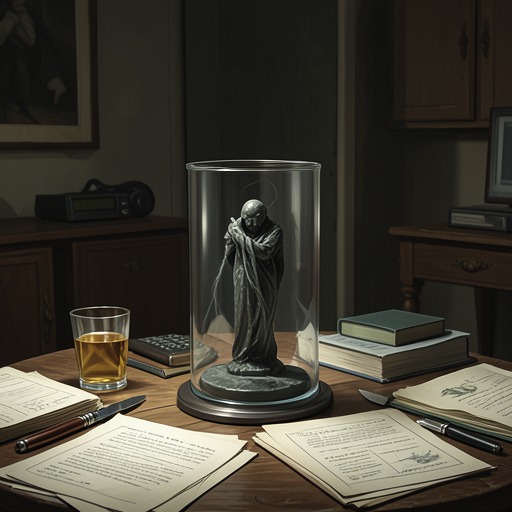
Currigan laboratory disaster
Roadside PicnicThe Currigan laboratory disaster is a reported containment failure in which Witches' jelly escaped a room designed to isolate it and overwhelmed the Currigan Labs building. Its account turns a supposedly controlled experiment into evidence of how little ordinary barriers can guarantee when confronted with a substance whose behavior exceeds them: the jelly passed through metal and plastic, transformed what it touched, killed thirty-five people, crippled more than a hundred, and ultimately seeped into the lower parts of the building.
Background and supposed containment
The disaster is recounted in conversation as something the speaker has heard about, rather than as a scene witnessed directly. The description blames the researchers for believing they had isolated the danger. They put a porcelain container holding Witches' jelly in a specially insulated and isolated room, treating a designed enclosure as if it were proof of containment. The story's first reversal is already contained in that distinction: the room was isolated in intention, not in fact.
The container was opened with manipulators, equipment that allowed the researchers to handle it from outside. But the procedure did not prevent the jelly from escaping. The account offers no further detail about the experiment's purpose or the staff's expectations; its emphasis is on the misplaced confidence built into the precautions and the decisive failure that followed.
Escape and destruction
Once opened, the porcelain container did not hold the jelly. The substance passed through metal and plastic, materials expected to form barriers, and moved outside the container. The sequence makes the containment failure more consequential than a breakage or spill: neither the container nor the room's engineered safeguards stopped the spread.
Everything the jelly touched also turned into jelly. The disaster therefore expanded by contact, converting the immediate surroundings rather than remaining a substance in a single vessel. The reported human toll was thirty-five people killed and more than a hundred crippled. The entire building was destroyed, extending the consequences from the opening of one container to the loss of the facility itself.
Aftermath and significance
The escape did not end with the building's destruction. The jelly had seeped into the basement and lower floors, leaving the lower levels contaminated after the central disaster. The account does not say what happened to the site afterward or whether the spread was eventually stopped; it presents the seepage as an unresolved consequence, not a fully closed incident.
The disaster is introduced as a prelude to contact, a phrase that frames it against the wider prospect of encounter with the unknown without explaining the laboratory event's connection to any later development. Its details nevertheless make the danger concrete: specialized equipment, insulation, and isolation all prove insufficient, while the jelly's movement and transformative contact exceed the boundaries its handlers meant to impose. The report's matter-of-fact sequence—from the container's opening, through the breached barriers and human losses, to the jelly in the basement—sets a catastrophic event beside the language of controlled procedure and exposes the gap between intended safety and actual control.